BPC-157
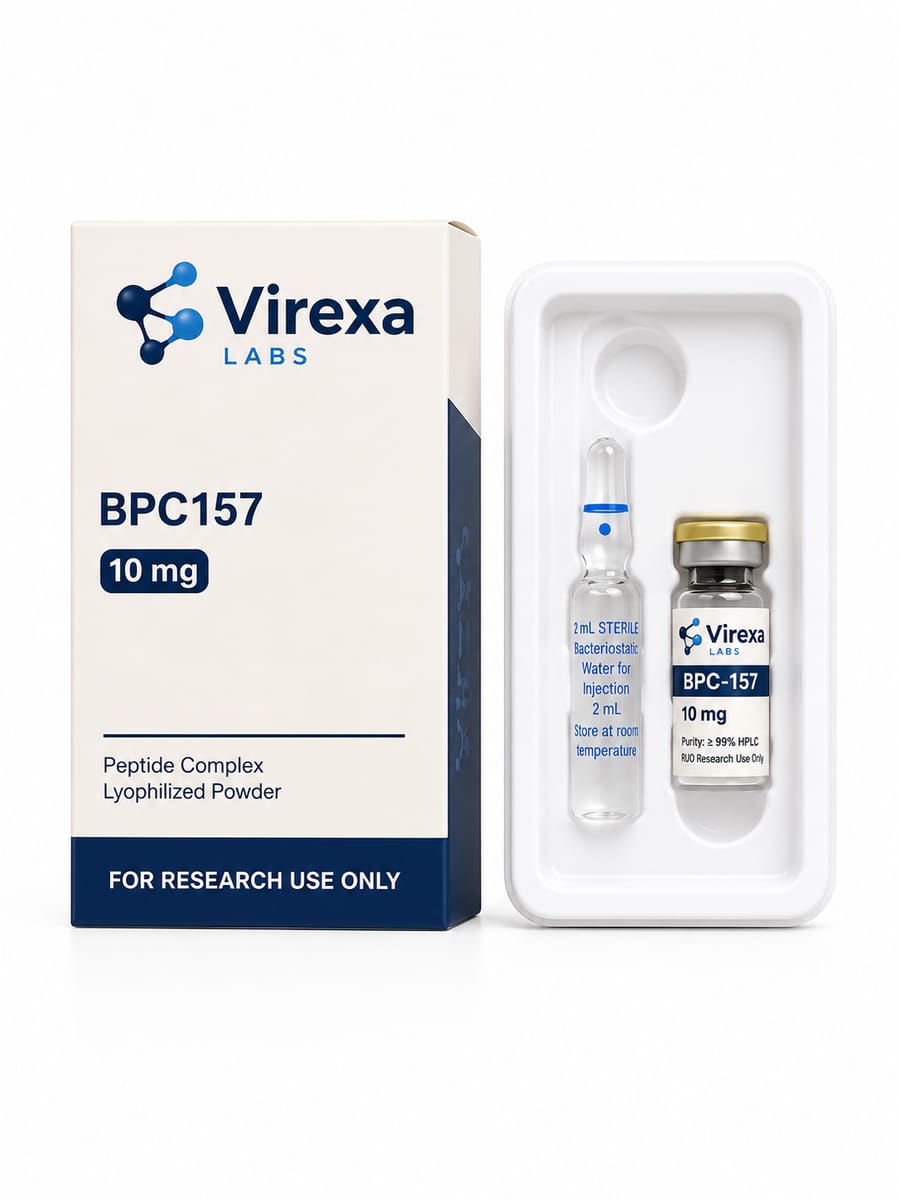
BPC-157 research peptide. Lyophilized powder, ≥99% purity by HPLC. For research use only.
About BPC-157
What is BPC-157?
BPC-157 – short for Body Protection Compound-157 – is a synthetic pentadecapeptide: a chain of 15 amino acids. It is one of the most widely studied research peptides in preclinical tissue-repair science and has been the subject of a large body of animal and cell-culture work over the past decades.
Virexa Labs supplies BPC-157 as a lyophilised powder for in-vitro laboratory research only. It is not intended for human or veterinary use, and nothing on this page should be read as a claim of an effect in people.
Structure and origin
The sequence of BPC-157 (Gly-Glu-Pro-Pro-Pro-Gly-Lys-Pro-Ala-Asp-Asp-Ala-Gly-Leu-Val) corresponds to part of a larger protein – the so-called body protection compound – that was described in human gastric juice. Researchers today work with this synthetic 15-amino-acid fragment rather than with the original protein.
A property often highlighted in the literature is its notable stability: unlike many short peptides, BPC-157 has been reported to remain stable in gastric juice. That is one reason it features so often in gastrointestinal research models and in discussions about peptide stability in general.
Research areas
Published BPC-157 research is almost entirely preclinical. The main areas in which the peptide has been studied in animal and in-vitro models are:
- Tendon and ligament repair models, for example healing of transected tendons in rodents
- Muscle injury models and skeletal-muscle regeneration
- Gastrointestinal tissue models, such as lesions of the stomach and intestinal wall
- Angiogenesis – the formation of new blood vessels – and related growth-factor signalling
- Migration and survival of fibroblasts and endothelial cells in culture
Handling, reconstitution and storage
Store lyophilised BPC-157 at −20 °C, dry and protected from light; 2–8 °C is fine for short periods. Let the vial reach room temperature before opening it, so no condensation forms on the powder.
Bacteriostatic water is usually used for reconstitution. Add the solvent slowly along the inside wall of the vial and swirl gently until the powder has dissolved – don't shake, as vigorous agitation can damage the peptide. Keep the solution at 2–8 °C, use it within about 4 weeks and avoid repeated freeze–thaw cycles.
When you buy BPC-157 for research from Virexa Labs, every batch has been tested by HPLC (≥99% purity) and mass spectrometry (identity). The certificate of analysis (COA) for the current batch is linked on this page.
Frequently asked questions
What is BPC-157?
BPC-157 (Body Protection Compound-157) is a synthetic 15-amino-acid peptide whose sequence derives from a protein found in human gastric juice. It is used as a research peptide in animal and in-vitro models of tissue repair and angiogenesis.
What is the difference between BPC-157 and TB-500?
They are unrelated molecules. BPC-157 is a 15-amino-acid fragment of a gastric-juice protein, while TB-500 is a synthetic peptide based on the actin-binding region of thymosin beta-4. Both are studied in tissue-repair models, but through different mechanisms – which is why they are also offered together as the Wolverine Blend.
How should I store BPC-157?
As a lyophilised powder at −20 °C, dry and dark (2–8 °C for short-term storage). Once reconstituted, keep it at 2–8 °C, use it within about 4 weeks and avoid repeated freezing and thawing.
What do I reconstitute BPC-157 with?
Bacteriostatic water is the usual choice. Add it slowly along the vial wall and swirl gently instead of shaking. The volume depends on the concentration your experimental protocol requires.
Is BPC-157 suitable for human use?
No. BPC-157 from Virexa Labs is sold strictly for in-vitro laboratory research. It is not a medicine or dietary supplement and is not intended for human or veterinary use.