Semax
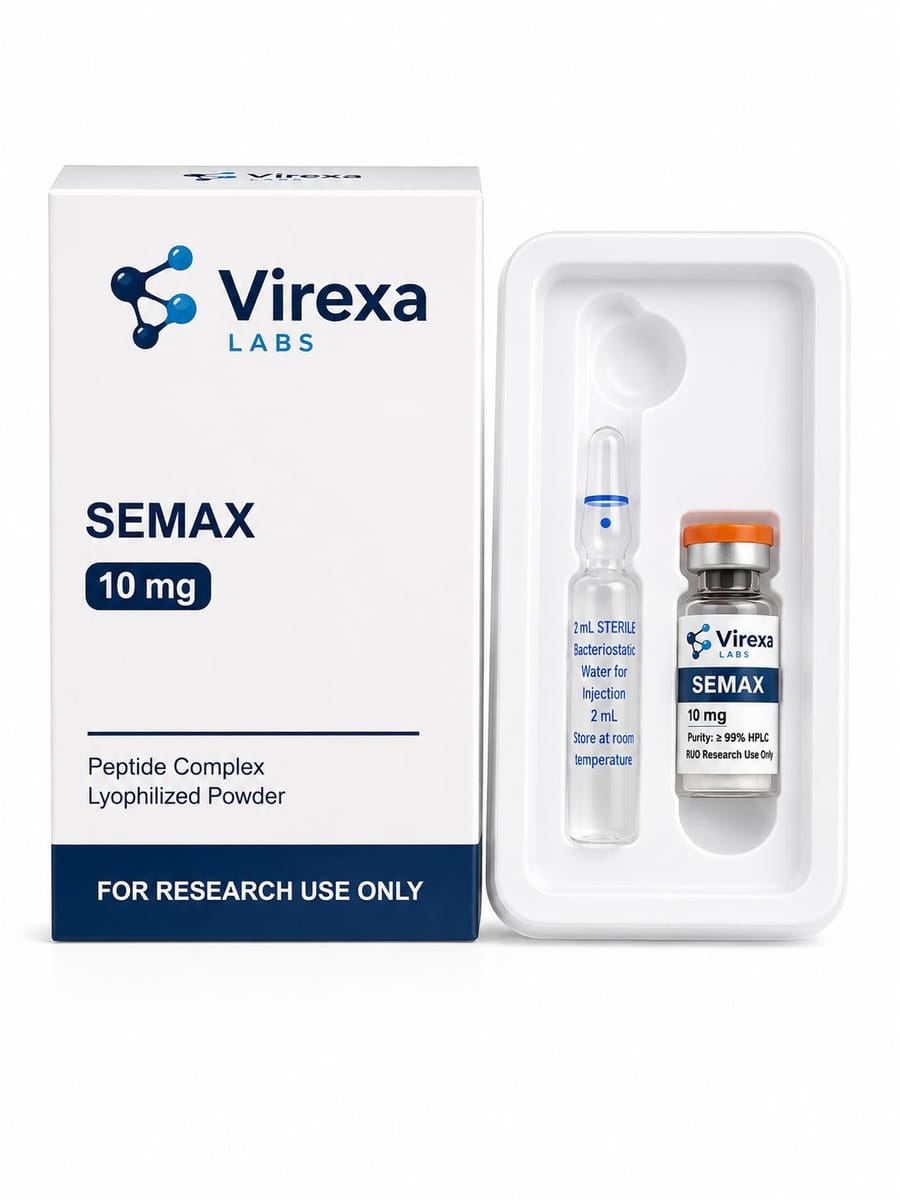
Semax research peptide. Lyophilized powder, ≥99% purity by HPLC. For research use only.
About Semax
What is Semax?
Semax is a synthetic heptapeptide – a chain of seven amino acids – with the sequence Met-Glu-His-Phe-Pro-Gly-Pro. It is an analogue of the adrenocorticotropic hormone fragment ACTH(4-10) and was developed in Russia at the Institute of Molecular Genetics of the Russian Academy of Sciences.
Virexa Labs offers Semax as a lyophilised research peptide for in-vitro laboratory research only. It is not intended for human or veterinary use.
Structure and origin
Semax combines the ACTH(4-7) sequence Met-Glu-His-Phe with a C-terminal Pro-Gly-Pro extension. Short ACTH fragments interest researchers because they lack the hormonal activity of full-length ACTH, but they are broken down quickly. The Pro-Gly-Pro tail was added to make the peptide more resistant to enzymatic degradation.
Semax is registered as a medicine in Russia, but not in the EU, where it is available only as a research peptide. The same institute later developed Selank, which uses the same Pro-Gly-Pro approach.
A large share of the published Semax literature comes from Russian research groups, mostly working with rodent models. Independent data from laboratories elsewhere are more limited – worth keeping in mind when planning new experiments.
Research areas
Semax has mainly been studied in animal and cell-culture models of the nervous system:
- Neuroprotection models, for example experimental cerebral ischaemia in rodents
- Expression of brain-derived neurotrophic factor (BDNF) and its receptor TrkB
- Gene-expression studies in nervous tissue
- Behavioural models of learning and memory in animals
Handling, reconstitution and storage
Store lyophilised Semax at −20 °C, dry and protected from light; 2–8 °C is fine for short periods. Bacteriostatic water is usually used for reconstitution: add it slowly along the vial wall and swirl gently instead of shaking.
Keep the solution at 2–8 °C, use it within about 4 weeks and avoid freeze–thaw cycles.
If you buy Semax for research from Virexa Labs, every batch is verified by HPLC (≥99% purity) and mass spectrometry, with the COA shown on this page.
Frequently asked questions
What is Semax?
Semax is a synthetic heptapeptide (Met-Glu-His-Phe-Pro-Gly-Pro), an ACTH(4-10) analogue with a Pro-Gly-Pro extension. It is studied as a research peptide in neuroprotection and BDNF-expression models.
What is the difference between Semax and Selank?
Both are heptapeptides with a stabilising Pro-Gly-Pro tail, developed at the same Russian institute. Semax is derived from the hormone fragment ACTH(4-10) and is studied in neuroprotection models; Selank is derived from the immune peptide tuftsin and is studied in stress and immunomodulation models.
Is Semax approved in the EU?
No. Semax is registered as a medicine in Russia, but has no marketing authorisation in the EU. Within the EU it is available only as a research peptide.
How do I store Semax?
Lyophilised at −20 °C, dry and dark (2–8 °C short term). After reconstitution with bacteriostatic water: at 2–8 °C, used within about 4 weeks.
Is Semax suitable for human use?
No. Semax from Virexa Labs is intended exclusively for in-vitro laboratory research and is not for human or veterinary use.